From Slow Opening to Sudden Stops: Diagnosing Common Garage Door Behavior

Steel Garage Doors: The Perfect Blend of Strength, Style, and Value
February 6, 2026
Why Is Your Garage Door Opener Flashing and What Should You Do About It?
February 19, 2026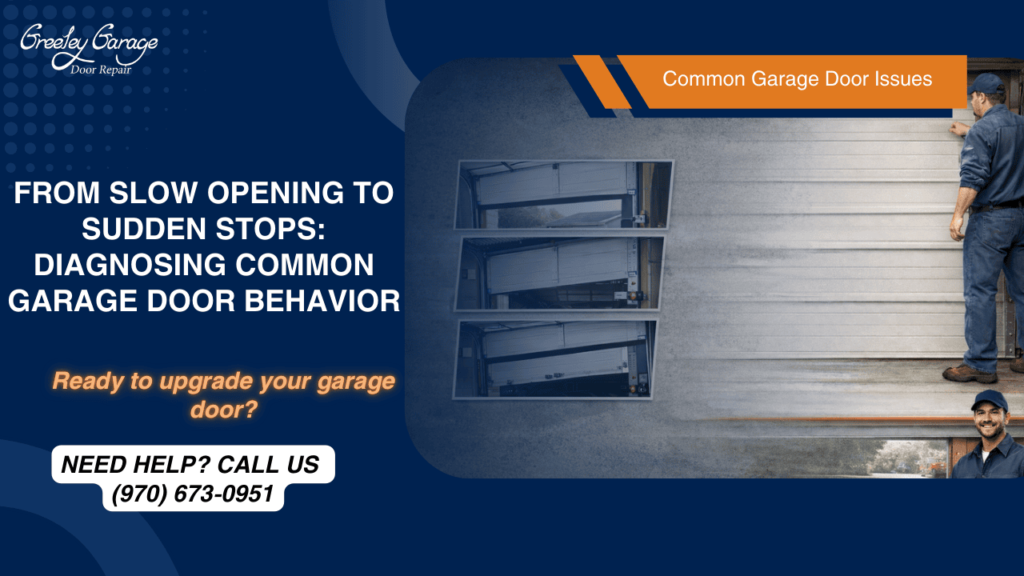
When your garage door starts acting up, it rarely happens without warning. Usually, it “talks” to you first—through a new squeak, a slight hesitation, or a sluggish lift. Ignoring these signs can turn a simple $50$ lubrication job into a $500$ emergency repair.
This guide helps you decode common garage door behaviors so you can identify the problem before it leaves you stranded in your driveway.
The Sluggish Opener: Why is it moving so slow?
If your door feels like it’s moving through molasses, the issue is usually one of two things: friction or fatigue.
- Dry Tracks and Rollers: Over time, the factory grease dries out and collects North Colorado dust. This creates resistance that forces the motor to work harder.
- Worn Springs: Garage door springs have a limited “cycle life” (usually $10,000$ to $20,000$ lifts). As they age, they lose their tension, meaning the opener is doing all the heavy lifting instead of the springs.
The “Half-Way” Reversal
Few things are more frustrating than watching your door almost close, only to have it pop back open immediately.
- The Safety Sensors: Check the small “eyes” at the bottom of your tracks. If they are misaligned or blocked by a stray leaf or cobweb, the door will reverse as a safety precaution.
- Travel Limits: Sometimes the opener’s internal logic gets confused. If it thinks the ground is higher than it actually is, it will hit the floor, “panic,” and retract.
Excessive Noise: Grinding, Squeaking, or Banging
A noisy door is a cry for help. The type of sound tells you exactly where to look:
- Squeaking/Screeching: Usually indicates metal-on-metal friction. It’s time for a silicone-based lubricant.
- Grinding: This often points to the drive gear inside the motor housing. If you see plastic “snow” (shavings) inside the opener, the gear is stripping.
- Banging/Popping: This is a classic sign of a “binding” track or a roller that is jumping out of place.
Common Diagnostic Checklist

The “Stuck” Door: Why it won’t move at all
If you hear the motor humming but the door isn’t moving, check the emergency release cord (the red string). It may have been pulled, disconnecting the door from the carriage. If the cord is fine and the door is shut tight, a spring has likely snapped.
Safety Warning: Never attempt to replace or adjust torsion springs yourself. Due to their extreme tension, they can cause severe injuries.
Conclusion
Diagnosing your garage door early is the best way to save money and ensure your home’s security. Most issues stem from simple wear and tear, but they require a trained eye to fix correctly and safely.
If you’re experiencing sudden stops or unusual noises, don’t wait for the system to fail—if you need professional garage door service, call us (970) 673-0951 today!